Africa's Trusted Outfitter Since 1999

Our Hunting Concessions
South Africa, Namibia, Botswana, Zambia
Online Support
info@kaiwhaisafaris.com
Free Call
(469)698-3030
Our Hunting Concessions
Online Support
Free Call
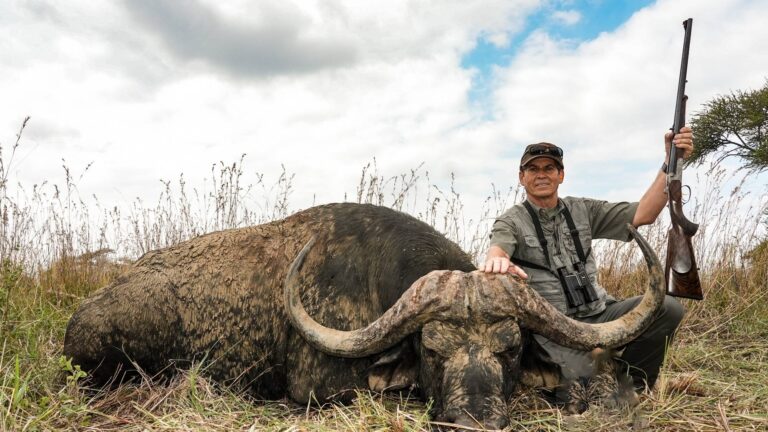
One of the Dangerous 7 · Syncerus caffer
The Cape Buffalo ( Syncerus caffer) claims its spot as the number 1 Bucket-list animal for most hunters visiting Africa. Widely referred to as The Black Death of Africa, the Cape Buffalo is seen as the most dangerous hunt of the Dangerous 7 animals.
At 2,000 Lbs of brute strength and muscle, it usually takes a couple of shots to bring him down. The Buffalo likes the thick vegetation and Bushveld habitat of Africa. A walk-and-stalk method is the only way to get close enough to these beasts. With their rock-hard bosses, you will often hear them crushing through the thick brush, and one can’t help but to have a shiver down your spine while hunting them.
At Kaiwhai Safaris we have some of the best quality Buffalo around! With our 100% success rate our clients knows they are there for a safe, successful, and rewarding hunt.
Watch a real hunt before you book one. All filmed on our own concessions for our show, Getaway To Africa.
More on our channel: Getaway To Africa on YouTube

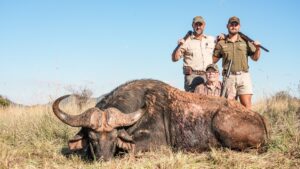
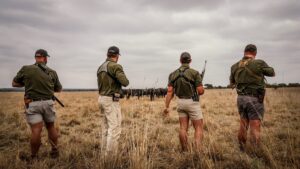
See the full Cape Buffalo gallery
The detail below is the working reference our professional hunters use in the field. Open whichever section you need.
One of the Big Five. A dangerous game animal; aggressive, vindictive, cunning. Cape buffalo can weigh up to three-quarters of a ton; exceptional eyesight, hearing, and sense of smell. Gregarious herd animals. Water-dependent coarse grazers; occasional browsers. Favours thick bush during daylight. Ruminants. Five subspecies are recognized
Can be difficult when visibility restricted. Both sexes carry horns, but cows do not have a boss. Mature bulls have thick, well-muscled necks, heavy, well-developed shoulders, blunt horn tips, a solid boss, and a distinctly visible penis sheath.
Look for wide outside spread, deep curl, and a solid boss. SCI method (4): sum of length in inches of both horns around the outside of the curl, combined with straight-line width of both bosses; only bulls may be entered. Roland Ward method (12): width of outside spread. When a mature bull is looking at you, outside spread of ear tips = 30-32 inches. A hand’s width (4 inches) of spread beyond the ear tips on both sides = +/- 4O-inch bull for RW measurement. With a solid boss, this is a good trophy.
Track, walk, and stalk. Buffalo need to drink daily; makes finding spoor easier. Warmth and freshness of dung good indicator of how far ahead they are. Watch/listen for oxpeckers, the hunter’s friend.
Shooting distances are usually short (20-120 paces) with majority of shots taken at 30-80 paces. -Legal minimum is 9.3x62mm, 9.3x74R, or .375 H&H, depending on country. Larger calibres, .40s and .458s, more effective. Premium-quality expanding bullets for initial’ well-positioned shots; solids for all backing ones. Good-quality, low-power or 1-4X variable scope an advantage.
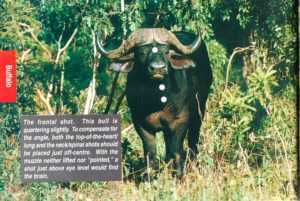
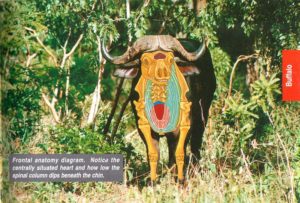
Shot placement on any of the dangerous game in Africa is vital. Below are some images from a very well-known author, Kevin Robertson’s Book – Perfect Shot Placement for African Big Game. If you would like to buy a copy of this book, which we would recommend, you can get it on Amazon, by clicking here
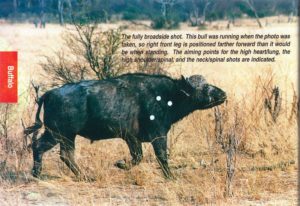
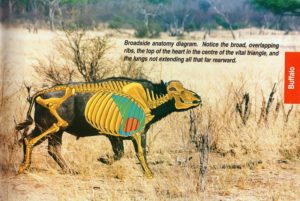
The legal minimum is 9.3x62mm, 9.3x74R or .375 H&H, depending on which country you hunt in. Larger calibres - the .40s and .458s - are more effective. Use premium-quality expanding bullets for the first, well-placed shot and solids for every backing shot. A good low-power or 1-4x variable scope is an advantage.
Shooting distances are usually short - 20 to 120 paces, with the majority of shots taken at 30 to 80 paces. You track, walk and stalk into them, often through thick bush.
Look for a wide outside spread, a deep curl and a solid boss. When a mature bull is looking at you, the outside spread of his ear tips is 30 to 32 inches. A hand's width - about 4 inches - of spread beyond the ear tips on both sides puts him around a 40-inch bull on the Rowland Ward measurement. With a solid boss, that is a good trophy.
Yes. We have taken Cape buffalo with a bow - there is footage of it on this page. Talk to us early, because bow hunting dangerous game has its own requirements.
On our concessions in South Africa, Namibia, Botswana and Zambia. Which area suits you depends on the time of year and the kind of bull you are after - ask us and we will match you to the right one.
Tell us roughly when you would like to travel and what you would like to hunt. We will come back to you with what is available, what it involves and what the paperwork needs - no obligation.