Africa's Trusted Outfitter Since 1999
Our Hunting Concessions
South Africa, Namibia, Botswana, Zambia
Online Support
info@kaiwhaisafaris.com
Free Call
(469)698-3030
Our Hunting Concessions
Online Support
Free Call

One of the Dangerous 7 · Crocodylus niloticus
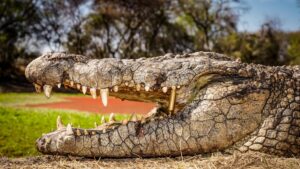
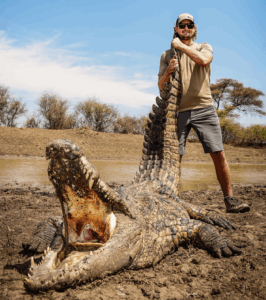
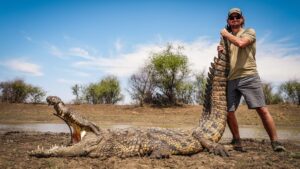
Nile Crocodiles (Crocodylus niloticus) are opportunistic apex predators; a very aggressive species of Crocodile, they are capable of taking almost any animal within their range. These prolific dinosaurs are a treat to hunt, seeing that you must literally outsmart them. They grow to over 18ft and can disappear under water in an instance.
Crocodiles have receptors under their head and body, feeling the vibrations of animals or hunters approaching them. You usually wait for them during the mid-day to come out and bake in the sun. A very slow walk-and-stalk or waiting for them in a specific location is the way to hunt them. You never shoot a Crocodile in the water, as they will not float like a Hippo. A kill shot on the bank is necessary for them. Coming up close to a predator that have survived for millions of years will always be a special moment.
We have multiple areas where we hunt crocodiles. Certain areas will have different size crocodiles and if you have a specific size in mind we will send out scouts ahead of time and make sure we get you the monster you are looking for.
Watch a real hunt before you book one. All filmed on our own concessions for our show, Getaway To Africa.
More on our channel: Getaway To Africa on YouTube

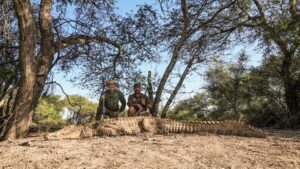
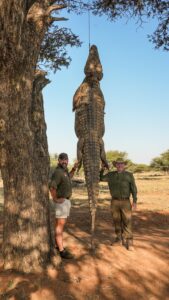
See the full Nile Crocodile gallery
The detail below is the working reference our professional hunters use in the field. Open whichever section you need.
One of Africa’s most unusual trophies. Known locally as Ngwena, “crocs,” “flat dogs,” or simply ” flatties.” Shy, wary, and cautious, egg-laying reptiles; cold-blooded. Nocturnal feeders; spend hours of darkness in water. Diet primarily fish. Bask in sun to “re-energize.” Long-living, slow-growing creatures. Trophy-sized specimens will be 75 to 100 years old. Bull crocodiles are territorial. Patrol territories regularly. Extremely difficult to approach on foot to within a reasonable shooting distance.
With young crocodiles, virtually impossible; easier with trophy-sized crocs. Big bull crocodile will have a large, noticeably broad head and wide, well-rounded, V-shaped muzzle. Entire head will have a knobby appearance, gums receded, teeth distinctly visible. Neck thick, broad, and muscular, with well’ developed, fleshy jowls to the sides. Eyes relatively far apart. Female’s head more slender, muzzle parallel sided. Females rarely longer than 12 feet.
Difficult to estimate body length accurately. A really big croc will just look “big”; back and neck extremely wide; large and round belly; fleshy, well-developed jowls, Estimate straight-line length, in inches, from nostrils to eyes; this length in inches approximately equal to total body length in feet. Regardless of sex, 12 feet= good trophy, >13 feet = really good, >14 feet = exceptional, >15 feel = phenomenal. SCI method (16C): Length of body along line of body. Roland Ward method (18): length of body peg to peg.
Extremely challenging to hunt; see, hear, and smell extremely well; also able to detect ground vibrations and have “feathered watchdogs.” Absolutely precise first-shot placement essential to “anchor” a big croc successfully. Ambush known basking site. Baiting the most successful hunting method. Secure bait at water’s edge. Use any form of meat as bait. Replenish daily until territorial bull has eaten his fill and lies next to bait to guard it. Build blind downwind. Shooting distance: longest range at which a golf-ball-sized target can be hit with the chosen rifle/calibre/scope combination (50-80 paces). Stable shooting rest essential (sandbags). Measure blind/bait distance carefully. Sight rifle in at this distance.
Trophy-sized croc requires surgically precise first shot placement. Selection must be capable of this. The .338s or .35s and 250-grain premium-quality soft point bullets a sensible minimum. Larger calibres, 9.3mms and .375 H&H, a better choice if sufficiently accurate. Quality expanding bullets essential. Scope also essential: 1.5-5X variable a good choice.
“Anchoring” first shot requires knowledge of skull and neck. Brain golf-ball sized and lies midway between eyes and ear ridges, two inches below eye level.
Shot placement on any of the dangerous game in Africa is vital. Below are some images from a very well-known author, Kevin Robertson’s Book – Perfect Shot Placement for African Big Game. If you would like to buy a copy of this book, which we would recommend, you can get it on Amazon, by clicking here
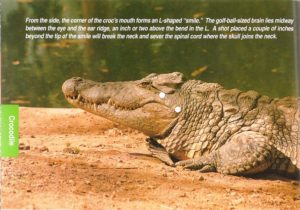

Because it will not float the way a hippo does – you would lose it. A kill shot on the bank is necessary.
Regardless of sex, 12 feet is a good trophy, over 13 feet is really good, over 14 feet is exceptional and over 15 feet is phenomenal. A trophy-sized croc will be 75 to 100 years old.
A trophy croc needs a surgically precise first shot, so accuracy matters more than power. The .338s or .35s with 250-grain premium soft points are a sensible minimum; 9.3mms and .375 H&H are a better choice if they are accurate enough. A scope is essential – a 1.5-5x variable is a good choice.
Yes. We hunt crocodile in several areas and different areas hold different sizes. If you have a specific size in mind we send scouts out ahead of time to make sure we get you the monster you are looking for.
Tell us roughly when you would like to travel and what you would like to hunt. We will come back to you with what is available, what it involves and what the paperwork needs – no obligation.