Africa's Trusted Outfitter Since 1999
Our Hunting Concessions
South Africa, Namibia, Botswana, Zambia
Online Support
info@kaiwhaisafaris.com
Free Call
(469)698-3030
Our Hunting Concessions
Online Support
Free Call
Hunting in Africa often takes us into rugged, untamed terrain where ordinary vehicles simply won’t do. At Kaiwhai Safaris, we use specially customized hunting vehicles designed to handle the toughest conditions, transport hunters comfortably, and safely recover game after the hunt.
If you are travelling from the United States, the hunting truck is probably the part of an African safari you have pictured least and will remember most. You will spend more hours in it than anywhere except your bed. This page explains exactly what you will be riding in, how we use it, and — just as importantly — how we don’t use it.
All of our hunting trucks are 4×4 vehicles, built to access areas with little to no roads. This makes them not only practical but also part of the adventure—off-road drives across rocky ground, rivers, and bushveld tracks add to the excitement of your safari as we scout for game.
Every vehicle we own is a Toyota Land Cruiser — the 79-series, the same workhorse that professional hunters, game capture teams and anti-poaching units across southern Africa rely on. There is a reason you will see them everywhere from the Kalahari to the Zambezi: they are simple, immensely strong, and repairable in the field with basic tools. Ours are fitted out for hunting from the ground up:
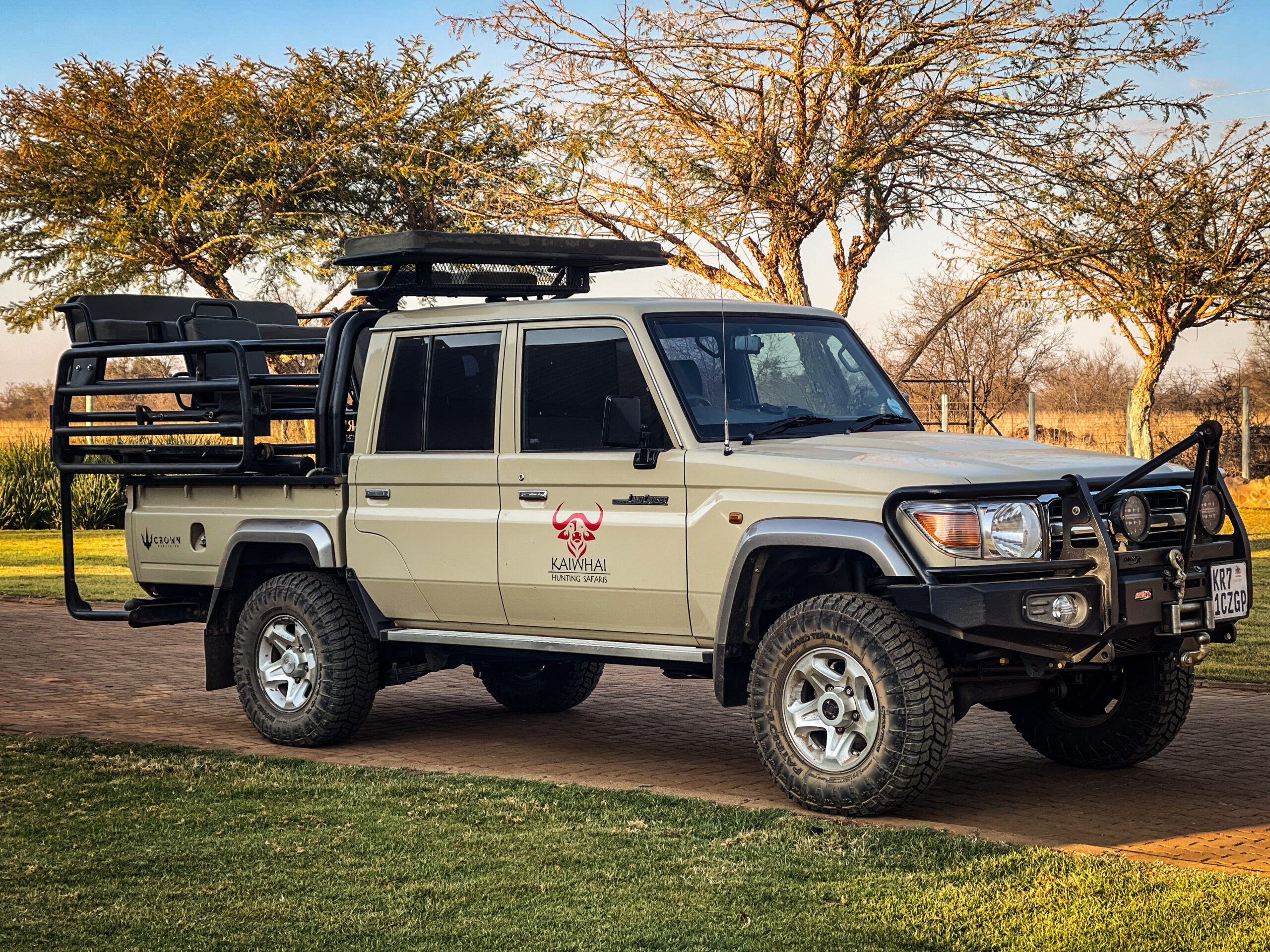
Each vehicle is fitted with a purpose-built hunting frame. These frames feature:
The raised bench matters more than it looks. It puts your eyes roughly eight feet above the ground, which is the difference between looking into long grass and thornveld and looking over it. Most of the animals you end up hunting will be spotted from that seat, by you or by the tracker sitting beside you, long before they know a vehicle is anywhere near.

For American hunters this is usually the first real question, and it deserves a straight answer rather than a brochure one. Back home, shooting from a vehicle is illegal in virtually every state and is considered poor sportsmanship on top of it. So it is fair to ask what a “hunting vehicle” actually means over here.
The default is simple: we glass from the truck and we hunt on foot.
A typical stalk goes like this. We drive the tracks and firebreaks of the concession at walking-to-jogging pace, glassing constantly from the high seat. When we find an animal worth a closer look, the truck stops — usually well short, and often out of sight behind cover. You climb down, the rifle comes out of its case, and from there it is you, your professional hunter and a tracker on foot, working the wind. Some stalks take fifteen minutes. Some take four hours and end with nothing but a good story and sore feet. The truck either waits where you left it or loops around to meet you at an agreed point on the radio.
We never use vehicles to drive or herd animals toward a waiting hunter. That is not a marketing position — it is written into our Code of Hunting Ethics, alongside our commitment to fair chase, free-range areas, and never hunting caged or trapped animals.
There is one exception, and it is about the hunter rather than the animal. If a client genuinely cannot make the stalk — knees, hips, a back that has had enough, lungs that will not do a mile of broken ground — we will set him up to take the shot from a stationary vehicle rather than tell him to stay at the lodge while everyone else hunts. It is arranged with your professional hunter beforehand, not improvised halfway through the day, and it is the same animal in the same free-range country that anyone else would have walked in on. If that describes you, say so when you enquire. For every other client, on every ordinary day, the shot is fired standing on the ground.
Two other things are worth naming rather than leaving you to wonder about them. Night hunting of predators such as jackal and caracal is its own discipline, done from a fixed elevated frame under the permits and provincial regulations that apply to it. And management culling operations are a conservation and herd-management activity rather than trophy hunting, conducted differently again. Both are explained further down this page.
Days vary with the species, the area and the weather, but the shape of one looks like this:
Total time in the vehicle on a full day is commonly six to nine hours, in stints rather than one long haul. Nobody is strapped into a seat for that whole time — you are up and down off the truck all day.
Firearm handling around the vehicle follows one rule, and your professional hunter will enforce it without apology: no loaded rifle rides in the truck. Inside the vehicle every rifle is unloaded, and it stays unloaded until your boots are on the ground.
Once you are off the truck and the stalk is on, rifles are loaded and on safe — and they stay on safe for the whole approach, however long it takes and however close it gets. A rifle is made ready to fire only when you are on the sticks and the shot is about to happen. Before anyone climbs back onto the vehicle, it comes unloaded again.
For bringing your own rifle into the country, the temporary import paperwork and what the airlines expect, see our Firearm Info page. Rental rifles are available if you would rather not travel with your own.
Every truck carries a cooler stocked with cold water and soft drinks, ensuring hunters stay refreshed and hydrated during the warm African days. On longer days a packed lunch and coffee travel with us, and there is no rush to be back at the lodge if the hunting is good where we are.
One thing that catches nearly every first-time American visitor by surprise: African winter mornings are cold. Our prime hunting season runs through the southern-hemisphere winter, roughly May to August, and a dawn start on the highveld or in the Kalahari can begin within a few degrees of freezing. Add an open vehicle moving at 25 miles an hour and the wind chill is genuinely biting. By ten in the morning you will be in shirtsleeves wondering what the fuss was about.
So: dress in layers you can shed. A windproof jacket, a beanie and a pair of gloves take up almost no room in a duffel and will be the best-value items you pack. A buff or neck gaiter earns its place against dust as much as cold. Our What to Bring on an African Safari list covers the rest.
A hunting truck is rarely just you and a driver. On a normal day the crew is your professional hunter, a tracker whose eyes will embarrass yours for the first few days, and a driver or skinner who handles the vehicle and the recovery work.
Tell us your group size when you enquire and we will tell you exactly how the vehicles will be allocated. As a rule we keep hunter numbers per truck low — a crowded vehicle spots less game and stalks worse.
Not every hunter can swing up onto a bench eight feet off the ground, and nobody should feel they need to pretend otherwise. Bad knees, a replaced hip, a back that has had enough, a service-related injury, or simply being eighty years old and not minding one bit — none of these have to end a safari.
Talk to us before you book, not after you arrive — the earlier we know, the better we can plan the areas and the species. See Medically Assisted Safaris, and for veterans, our US Veteran Hunts.
For night hunts, one of our vehicles is equipped with a specialized elevated night-hunting frame. Designed to rise above tall grass, this frame provides a clear vantage point for hunting species such as jackal and caracal. It features:
Night hunting of predators is a different discipline to daytime plains game hunting, and it is genuinely addictive. It is conducted under the permits and provincial regulations that govern it, and it is aimed at the damage-causing predators that farmers and game ranchers in the region contend with year-round. If jackal or caracal are on your wish list, mention it when you enquire so the right vehicle and the right nights are set aside for you.

On our South African property, we also operate an R44 helicopter. While primarily used for game capturing and relocation, the helicopter plays an important role in specialized safaris, including:
To be completely clear, because it is a reasonable thing to wonder about: trophy animals are never hunted from the air. The helicopter’s role in a normal safari is logistics and, occasionally, finding a wounded animal quickly so that the team on the ground can follow up and finish the job properly — which is exactly what our code of ethics demands of us. Culling and game-capture work are permitted wildlife-management operations, entirely separate from the trophy hunting we guide.
Concessions this size have patchy cell coverage at best, which is why every vehicle carries a two-way radio and why the aerial on the back is as long as it is. The camp, the trucks and the professional hunters stay in contact all day.

Normally no — we glass from the vehicle and hunt on foot. The one exception is about the hunter, not the animal: a client who genuinely cannot make the stalk can be set up to take the shot from a stationary vehicle, arranged with his PH beforehand. Separately, night predator hunting is done from a fixed elevated frame, and culling is a permitted management operation. All three are explained above.
Six to nine hours on a full day, but in stints, and broken up constantly by stalks on foot. Most hunters walk more in a week here than they expect to.
The tracks are uneven but the speeds are low, and the high seat in open air is far kinder to a sensitive stomach than a closed cab. Tell your PH and you can ride up front.
Yes. If you bring your family on safari they are more than welcome to join the hunt — not just ride along, but be part of the day. Many partners come out for the morning session and head back to the lodge after brunch.
Layers. Winter dawn starts can be near freezing with real wind chill, and the same day can reach the eighties by lunchtime. A windproof jacket, beanie and gloves for the morning, shirtsleeves by mid-morning.
In a padded scabbard on the frame, unloaded with the action open. It is loaded only once you are off the vehicle and on the stalk.
Coverage in the field is patchy and deliberately not something we chase. Camp has connectivity, and the vehicles stay in radio contact all day.
Winch and sliding tailgate. The frames were built for exactly this, and the crew has done it more times than they can count.
Ask it. We would far rather answer an awkward question now than have you arrive with a doubt you never voiced. If there is something about the vehicles, the fair-chase side of things, or getting around the concession with a bad knee that you want straight talk on, send it through and one of us will answer personally.