Africa's Trusted Outfitter Since 1999

Our Hunting Concessions
South Africa, Namibia, Botswana, Zambia
Online Support
info@kaiwhaisafaris.com
Free Call
(469)698-3030
Our Hunting Concessions
Online Support
Free Call
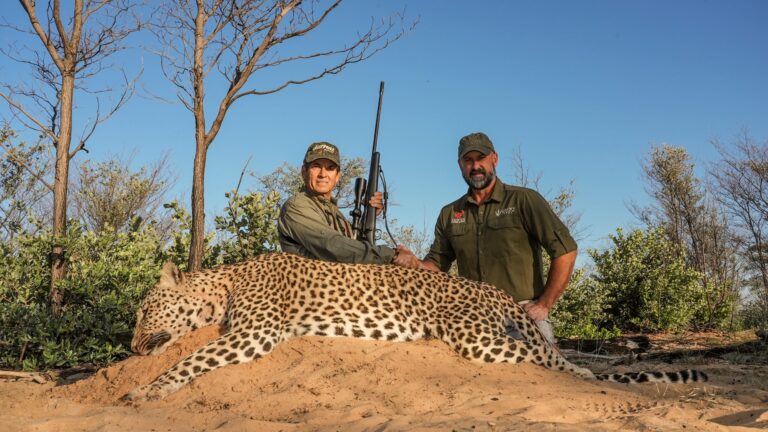
One of the Dangerous 7 · Panthera pardus
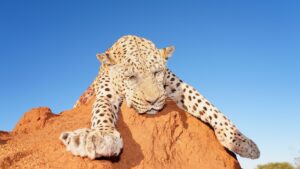
The African Leopard (Panthera pardus) inhabits a wide range of habitats within Africa, from mountainous forests to grasslands and Savannas, excluding only extremely sandy desert. The African leopard exhibits great variation in coat colour, depending on location and habitat. Coat colour varies from pale yellow to deep gold or tawny, and sometimes black, and is patterned with black rosettes while the head, lower limbs and belly are spotted with solid black.
The key to hunting a Leopard is being patient. They patrol huge, vast areas and baiting them in numerous locations often result in faster success. They have an incredible sense of smell, hearing and eyesight, thus they will avoid any area that’s seems just a little bit “different” than the way it was when they crossed it the day before.
With our knowledge and precision way of baiting these Leopards we have had 100% success rate on them. A Leopard hunt consists of early starting, long days, as you can never tell when he will come past your bait.
A Leopard is very aggressive and often charges after the first shot. This makes for an adrenaline filled hunt of a lifetime.
We have not published an African Leopard hunt on our channel yet. In the meantime, Getaway To Africa has more than 140 episodes of our hunts, and we are happy to talk you through an African Leopard hunt directly.

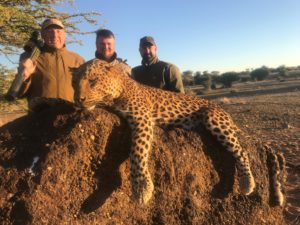
See the full African Leopard gallery
The detail below is the working reference our professional hunters use in the field. Open whichever section you need.
Smallest in body size and most widely distributed of Africa’s Big Five; most dangerous when wounded. Solitary animals, live in isolation. Shy and secretive, primary nocturnal. Can live without water if necessary by getting their moisture requirements from prey but will drink regularly if water available. Mature tom weighs between 120 and 180 pounds, female 70 to 130 pounds. Can consume as much as 20 percent of body weight at a single sitting. Strongly territorial. Effective and ruthless killers. Prey on virtually any meat source; also scavenge; like rotten meat. Life expectancy 12 to 15 years.
Difficult. Mature toms large, thickset, and well-muscled. Heads larger in relation to overall size. Mature females slender, not as well muscled, heads smaller, thinner necks. Male and female rarely seen together, so difficult to compare.
Body length (nose to tip of tail) used to determine size. Any tom >7 feet = good trophy; any tom >8 feet = huge. Size of spoor an aid to determining body size. Trophy leopard’s spoor will be 3.5 to 4 inches in length. Mature male nearly always has largest spoor; set up bait near its tracks. SCI method (15) and RW method (17): combined score in inches of skull’s length and greatest width.
Search for suitably sized spoor in areas where favoured prey most abundant-near water holes, pans, river pools; select suitable blind site (be able to get in and out unseen) and hang bait. Bait tree not too exposed, Easy access to blind most important. lmpala usually make best bait; also, warthog, bushpig. Drag bait area well, but do not overdo “scent.” Build blind 50-120 paces downwind of bait once it has been fed on. Stable shooting rest in blind most important. Sit still; leopard have phenomenal eyesight and hearing. Communicate only by gestures. ln dry, sandy areas, tracking also used as a hunting method.
A 7mm is as low as one should go. ln some African countries various 9.3mms or .375 H&H are minimum legal calibres for all dangerous game, including leopard. Bullets suitable for leopard should be relatively light and fairly fragile so as to rapidly release kinetic energy (hydrostatic shock). A good-quality, light-gathering scope with bold, easily visible, or illuminated reticle essential.
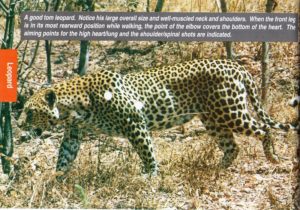
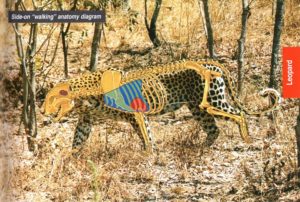
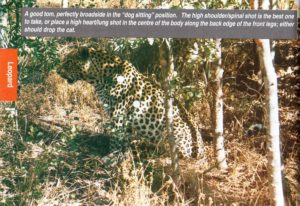
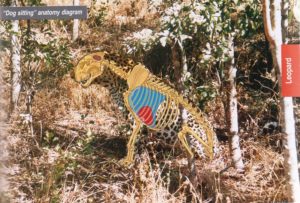
Leopard particularly susceptible to hydrostatic shock. Heatt positioned well back in chest cavity.
Shot placement on any of the dangerous game in Africa is vital. Below are some images from a very well-known author, Kevin Robertson’s Book – Perfect Shot Placement for African Big Game. If you would like to buy a copy of this book, which we would recommend, you can get it on Amazon, by clicking here
By baiting. We look for a suitably sized track where the leopard's favoured prey is most abundant – near water holes, pans and river pools – hang a bait, and build a blind 50 to 120 paces downwind once the leopard has fed on it. Impala usually makes the best bait, along with warthog and bushpig. In dry, sandy areas we also track.
Body length, nose to tip of tail. Any tom over 7 feet is a good trophy; any tom over 8 feet is huge. The size of the track helps – a trophy leopard's spoor will be 3.5 to 4 inches long.
A 7mm is as low as one should go, and some African countries set 9.3mm or .375 H&H as the legal minimum for all dangerous game including leopard. Bullets should be relatively light and fairly fragile so they release energy quickly. A good light-gathering scope with a bold or illuminated reticle is essential.
Longer than you think. Leopard will avoid any area that seems even slightly different from the day before, so the hunt runs on the cat's timetable, not yours. Tell us your dates and we will be straight with you about what is realistic.
Tell us roughly when you would like to travel and what you would like to hunt. We will come back to you with what is available, what it involves and what the paperwork needs – no obligation.