Africa's Trusted Outfitter Since 1999
Our Hunting Concessions
South Africa, Namibia, Botswana, Zambia
Online Support
info@kaiwhaisafaris.com
Free Call
(469)698-3030
Our Hunting Concessions
Online Support
Free Call
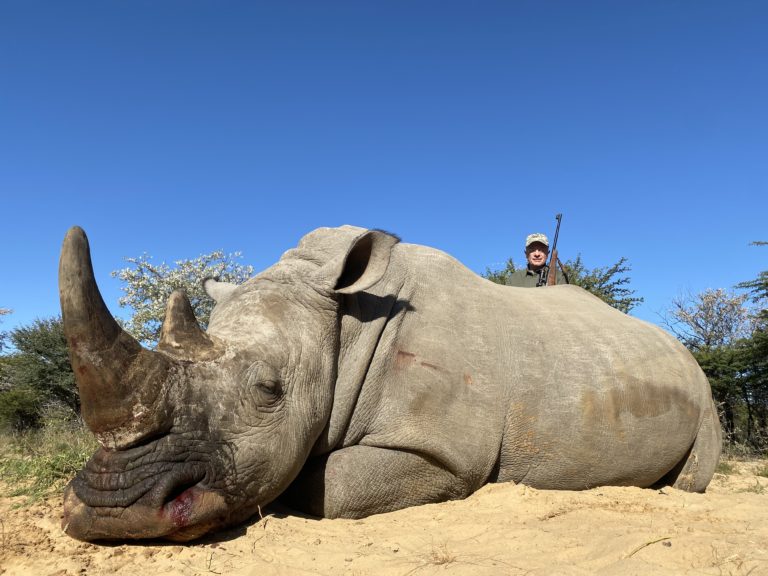
One of the Dangerous 7 · Ceratotherium simum / Diceros bicornis
When it comes to a Rhino hunt, it is always a touchy subject. The worldwide effort to save Rhinos against illegal poaching is a reality. At Kaiwhai Safaris our number of privately owned Rhinos grows every year, through sustainable hunting, that gives the animal value. Thus we breed excessively with them, and together with the hundreds of other private reserves that have Rhino breeding populations, this ensures that they will not go extinct. There are more Rhino in Africa today than in the last 30 years.
The Rhino is seen as the Armoured Truck of the Bushveld. They are the strongest of them all and although they have poor eyesight, they have an exceptional sense of smell and hearing. The speed that these huge animals can run at is often misjudged by hunters. It makes for a very challenging walk-and-stalk.
At Kaiwhai Safaris we have a 100% success rate on Rhino hunting, and we have all the legal permits for this truly once-in-a-lifetime hunt. We hunt the older bulls, that have passed their age of breeding, making it a humane and rewarding hunt.
We have not published a Rhino hunt on our channel yet. In the meantime, Getaway To Africa has more than 140 episodes of our hunts, and we are happy to talk you through a Rhino hunt directly.
The detail below is the working reference our professional hunters use in the field. Open whichever section you need.
One of the Big Five. White considerably larger than black, longer, broader, more prehistoric- looking head with broad muzzle, prominent hump in the neck and shoulder region. Weigh as much as 2.5 tons. Exclusively grazing animals, grass only diet; lifespan up to 40 years. Social and relatively docile; aggressive only when actively courting or protecting young. Black rhino smaller in overall body size (a mature bull will weigh about a ton) with smaller, shorter head, rounder ears, distinct prehensile or hooked upper lip. Almost exclusively woody browsers. More temperamental than the white, may charge without provocation. Both types of rhinos carry two continuously growing “horns,” dense, hairlike skin outgrowths.
White rhino difficult, as some mature females attain the huge size of old males. Females’ horns may be longer than males’, but usually slenderer, with smaller bases. Behaviour upon defecation and urination is also a key. Checking the area below the tail is the best way to be certain of a rhino’s sex.
SCI method (8): length of both horns + circumference of both horns at bases. Roland Ward method (15): length of longest horn. Horn length of 25 inches = good, 28 inches = excellent.
Classified as dangerous but relatively docile. Dominant breeding bulls are strongly territorial, walk the same well-worn paths. Spoor large and easy to find on well-worn game trails and dirt tracks. Grazing animals. Spend the first and last few hours of daylight feeding out in the open, easy to spot from a distance. Have phenomenal hearing, well-developed sense of smell, but poor eyesight. Relatively easy to approach to within fifty paces. Must be done quietly and slowly, from downwind.
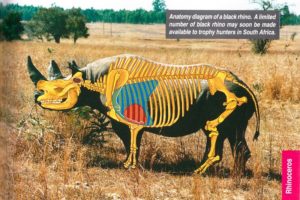
Rhino are considered pachyderms with good reason. Their skin is incredibly thick. Only the very best-quality solid bullets should be used, regardless of calibre. For quick and effective high heart/lung shots (the only shot recommended for a rhino), the 375 H&H and good 300-grain solids are as low as one can legally go. Larger calibres are more effective.
Shot placement on any of the dangerous game in Africa is vital. Below are some images from a very well-known author, Kevin Robertson’s Book – Perfect Shot Placement for African Big Game. If you would like to buy a copy of this book, which we would recommend, you can get it on Amazon, by clicking here


Hunting white rhino is completely legal when it is done with the correct paperwork and permits, which we hold. All our rhino hunts are conducted responsibly, ethically, and in full compliance with conservation regulations.
On privately owned land it has done the opposite. Sustainable hunting gives the animal value, so we breed them heavily – and together with hundreds of other private reserves with rhino breeding populations, that is why there are more rhino in Africa today than in the last 30 years.
Older bulls that have passed their breeding age. That is what makes it a humane and rewarding hunt rather than a loss to the population.
Because of the controversial views surrounding rhino hunting we do not share extensive details or media publicly. If you would like to see specific photos or know more, contact us directly and we will talk you through it.
Tell us roughly when you would like to travel and what you would like to hunt. We will come back to you with what is available, what it involves and what the paperwork needs – no obligation.