Africa's Trusted Outfitter Since 1999
Our Hunting Concessions
South Africa, Namibia, Botswana, Zambia
Online Support
info@kaiwhaisafaris.com
Free Call
(469)698-3030
Our Hunting Concessions
Online Support
Free Call
At Kaiwhai Safaris, we provide world-class rifle hunting across South Africa and Namibia, offering a wide variety of landscapes—from traditional bushveld to semi-desert terrain. Every hunt we conduct is based on our commitment to ethical, sustainable, fair-chase hunting. This ensures not only a thrilling and rewarding safari but also contributes to the long-term conservation of the species we pursue.
We typically recommend a 7 to 10-day safari, depending on the animals you wish to hunt and the size of your group. However, for those looking for a deeper immersion into Africa’s wilderness, we gladly arrange extended hunts. Our concessions are vast, rich with game, and it is our hallmark to harvest only mature, top-quality trophy animals.
The rest of this page is the practical detail most American hunters want before they commit: what rifle to bring, what bullet, what your scope should be, where to put the shot on an animal built differently to a whitetail, and how to practice for it. If you would rather talk it through than read it, just ask us — a real person answers.
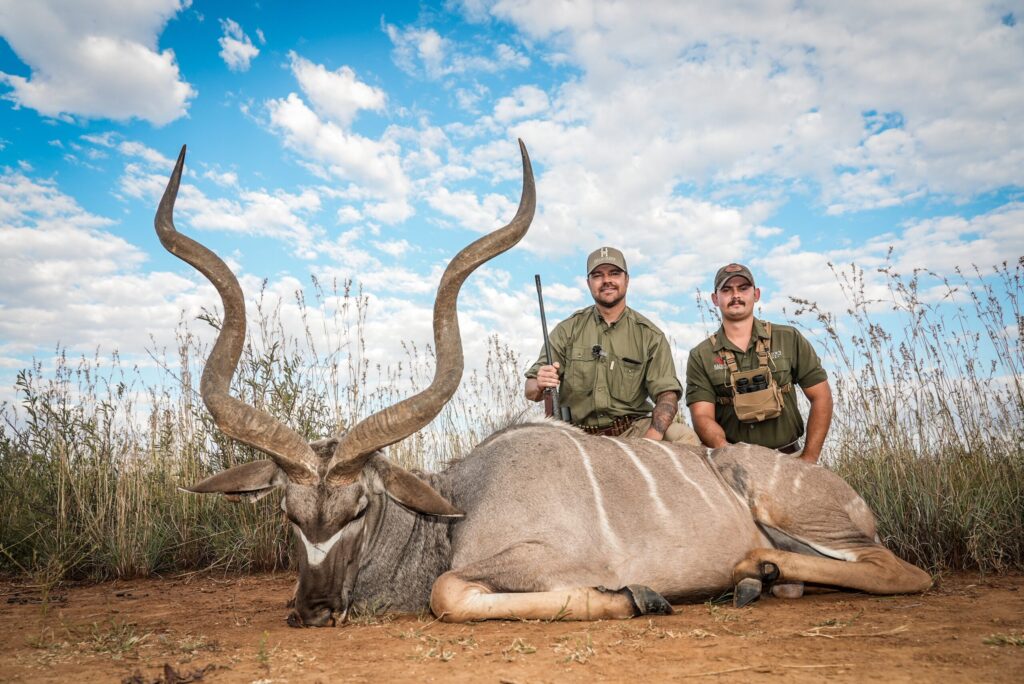
Most of our hunts are conducted using the traditional walk-and-stalk or spot-and-stalk methods, which allow hunters to truly engage with the African landscape. These approaches require a moderate level of fitness, as covering ground is often necessary to secure a quality trophy. For those who prefer a less physically demanding hunt, we also adapt techniques such as ambush setups or driven hunts, ensuring every hunter enjoys a safari tailored to their abilities and preferences.
How the day itself unfolds is covered on our hunting vehicles page; if the walking is the part that worries you, see medically assisted safaris. What follows here is the rifle side of it.
The honest answer is that the rifle you already shoot well is almost certainly the right one. Familiarity beats ballistics every single time, and a hunter who knows his rifle in his sleep will out-shoot a man carrying something new and magnificent that he has fired thirty times.
A .30-06 or a .308 will handle every plains game animal we hunt, from a steenbok to an eland, with the right bullet behind it. The 7mm and .300 magnums do the same with a little more reach. If you own one of those and shoot it well, stop reading this section and go practice instead.
This is the single most useful thing on this page, and the mistake we see most often. African plains game is heavier-boned, thicker-skinned and far tougher than a North American animal of the same weight. A soft cup-and-core deer bullet that performs beautifully on whitetail can come apart on the shoulder of a blue wildebeest and leave you tracking.
Bring a premium bonded bullet (the kind where the core is chemically bonded to the jacket) or a monolithic solid-copper bullet. Both hold together, retain their weight and drive deep through heavy bone. Partition-style bullets are equally proven and have been putting African game down for decades. Your professional hunter is happy to talk specific loads before you buy a box.
Bring the heavier bullet weight for your caliber rather than the fastest. In a .30 caliber that means 180 grains rather than 150. Penetration is what you are buying.
Modest magnification, bright glass and a rugged mount beat a big target scope every time. A 3–9×40 or 2.5–10x is close to ideal; anything that starts at 4x or higher becomes a liability when a kudu stands up at forty yards in thick bush. Keep it wound down to its lowest setting as you walk and only turn it up when you have time.
Bring flip-up lens covers or a scope coat — African dust is relentless and it gets into everything. A sling is useful; a bipod much less so, because you will be shooting off sticks rather than off the ground.
Zero one to two inches high at 100 yards and you are dead on to roughly 200, which covers the overwhelming majority of shots you will be offered. Plan to confirm that zero before you hunt. Rifles get handled a great deal in transit and a scope that has been knocked is not something you want to discover on the kudu you flew eight thousand miles for.
If you take one thing away from this page, make it this. The vitals of an African antelope sit lower and further forward than most American hunters expect.
The classic American broadside shot — just behind the shoulder, a third of the way up — is often too far back on African game, and puts the bullet into liver or paunch rather than lungs. On a kudu, gemsbok or wildebeest, aim for the center of the shoulder, roughly a third of the way up the body. Break the shoulder and take the top of the heart with it. You lose a small amount of meat and you gain an animal that goes down within sight.
Three more things worth knowing:
There are no treestands here, no shooting houses, and very few chances to get prone in grass that is often chest-high. Nearly every shot you take here will be standing, off three-legged shooting sticks. Nothing else about hunting in Africa will feel as unfamiliar on day one, and nothing else is as easy to fix before you come.
Your PH carries the sticks, sets them and steps aside. You rest the fore-end in the vee, get your weight forward, pull the rifle firmly into your shoulder and squeeze. It is far steadier than it sounds and it takes most people an afternoon to learn — but learn it in your own backyard, not on a trophy animal with your heart going.
Build a set from three lengths of dowel and a bolt, or buy a cheap pair, and shoot from them at 100 and 200 yards until it feels ordinary. Nothing else you do to prepare will pay you back as well.
While many hunters prefer to travel with their own rifles, we recognize that it’s not always convenient. To make things easier, we provide a carefully selected range of reliable, well-maintained rifles for our clients to use. If you’d prefer to hunt with one of ours, simply let us know in advance and we’ll ensure you’re perfectly equipped. We keep most common calibers, so a rental is a genuine option rather than a compromise — and it is the simplest way to avoid the paperwork altogether.
If you do bring your own, the import limits and the paperwork are set out step by step on our Firearm Info page — read that before you book flights, and note that we meet you personally at the airport and walk your rifles through clearing with you. See also flights and traveling to Africa.
We hunt with rifles from Crown Precision Arms, a Texas builder whose lightweight, accurate rifles have proved themselves well on our concessions.
One of the unique advantages of hunting with Kaiwhai Safaris is that we operate in both South Africa and Namibia, each offering distinct terrains, hunting styles, and species.
Whether you choose the bushveld of South Africa or the semi-desert plains of Namibia—or decide to combine both—Kaiwhai Safaris ensures you experience the very best that African rifle hunting has to offer. If shooting at genuine distance is what you are after, see long range hunting.
Hunters who prepare enjoy their safari more, and it is not a large amount of work. In the three months before you travel:
With Kaiwhai Safaris, there are no hidden costs. Our safari packages include all the essentials—accommodation, meals, professional guides, field preparation of trophies, and more. This allows you to focus on the hunt itself without worrying about unexpected expenses. Please contact us directly for our detailed price list.
The full breakdown of what is and is not included, and the two ways we can quote you, are on our hunting packages page.
For over 25 years, we have been trusted by hunters worldwide to deliver authentic, professional, and highly successful hunting safaris. What makes us the best is our ability to combine prime concessions, ethical practices, and flawless planning with a personal touch that makes every client feel like family.
When you book with Kaiwhai Safaris, you’re not just hunting—you’re living the true African safari experience. Read what our clients say in our testimonials, or watch a hunt unfold on Getaway To Africa, our own television series.
Yes, for every plains game animal we hunt, eland included, provided you load a premium bonded or monolithic bullet at the heavier end of the weight range. For dangerous game you will need a .375 or larger.
Bring your own if you shoot it well — familiarity is worth more than anything else. Rent if the paperwork or the airline puts you off; we keep most common calibers and they are properly maintained.
Forty to sixty per rifle is plenty. The legal ceiling and how to pack them are on Firearm Info.
A 3–9×40 or 2.5–10x. Walk with it on its lowest setting. High minimum magnification is a genuine handicap in thick bush.
Center of the shoulder, about a third of the way up. African vitals sit lower and further forward than you are used to, and the American behind-the-shoulder hold is often too far back.
In South African bushveld, typically 60 to 150 yards. In Namibia, 150 to 300 is common. Nearly all of it standing, off sticks.
Yes, as long as they are different calibers — only one firearm per caliber per person is permitted. Many hunters bring a plains game rifle and a .375 for dangerous game.
Tell us when you book and we will arrange what we can. It is a good example of why the earlier you mention something, the better we can sort it.
We run that too. See bow hunting.
Tell us what you want to hunt, roughly when, and who is coming. We will tell you which concession suits, what rifle to bring for the species on your list, and what a realistic week looks like. Ask us anything — including the awkward questions. The first conversation costs nothing.
Ask about a rifle safari Plains game hunting Bringing your rifle